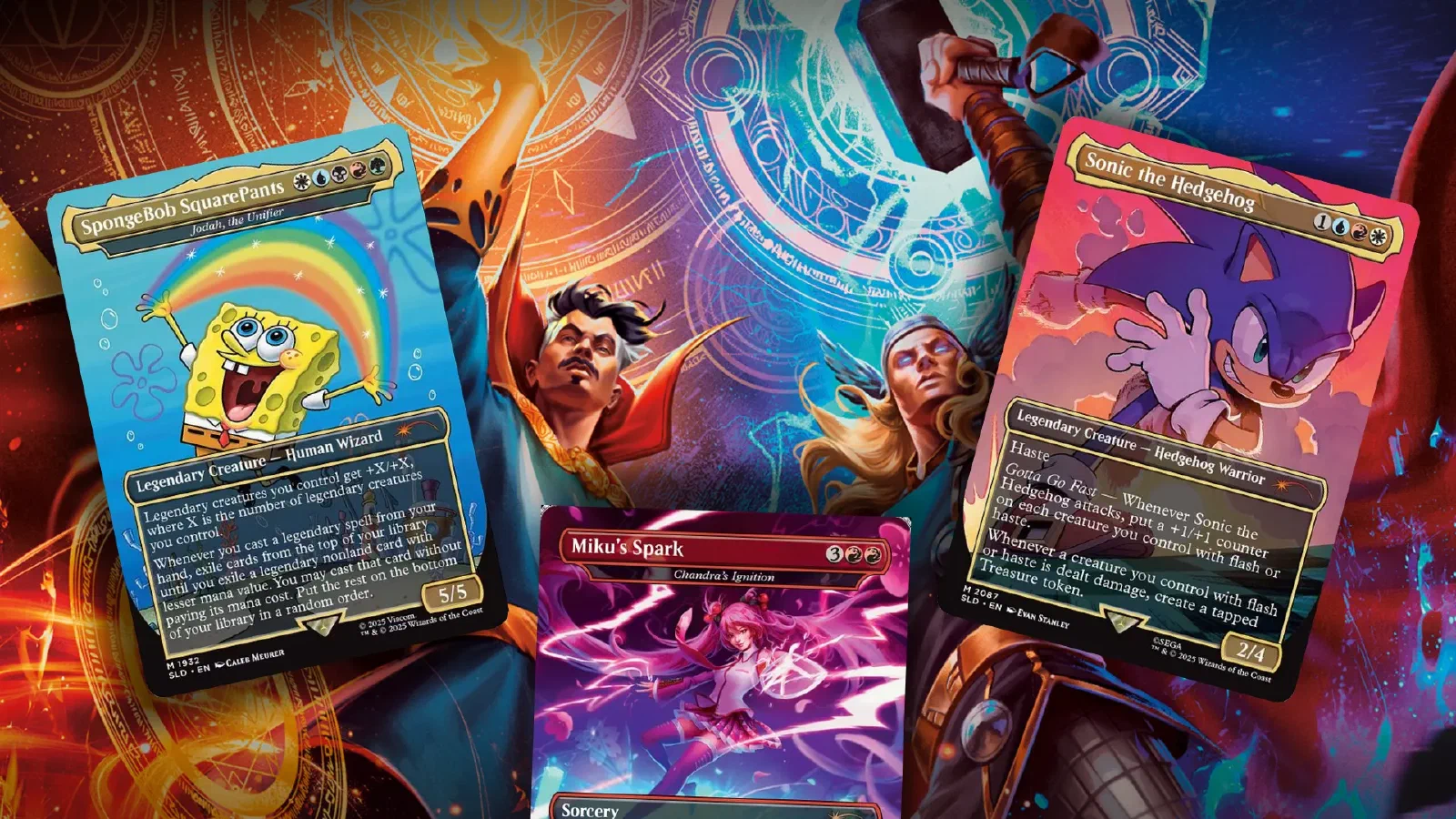
When Wizards of the Coast announced Universes Beyond in early 2021, the initiative that would bring characters and worlds from other franchises into Magic: The Gathering, reactions were swift. Some players welcomed the opportunity to see their favorite universes represented on Magic cards. Others, however, expressed concern about the potential impact on the game’s identity.
During the first few years, the discussion remained relatively contained. Many Universes Beyond products were aimed at Commander or other specific formats, and players who were not interested in them could simply ignore them. But the situation changed in late 2024 when Wizards announced that future premier Universes Beyond sets would become legal in Standard.
Starting with Final Fantasy (FIN) , released in June 2025, Universes Beyond ceased to be a parallel product line and became an integral part of Magic. With that change, the debate only grew louder.
The Arguments in Favor
Supporters of Universes Beyond tend to highlight several positive aspects.
The first is its ability to attract new players. Franchises such as Final Fantasy, Marvel, and The Lord of the Rings have enormous fan communities and can serve as an entry point into Magic for people who might otherwise never have considered playing the game.
Another common argument is that Magic has always been extraordinarily flexible from a thematic perspective. Over the years, we’ve visited worlds inspired by gothic horror, Greek mythology, fairy tales, cyberpunk, the American frontier, and detective stories. From that point of view, incorporating new universes is simply a natural extension of that diversity.
Supporters also argue that cards should primarily be judged by their design and the gameplay experiences they create. Many Universes Beyond products have been praised for their mechanics, their artistic direction, and the way they adapt elements from their source material. (That said, it is only fair to acknowledge that there have also been a few missteps along the way.)
Finally, some players believe these collaborations help keep the game culturally relevant and expand its reach beyond Magic’s traditional audience.
The Arguments Against
Critics, on the other hand, tend to focus on one central concern: Magic’s own identity.
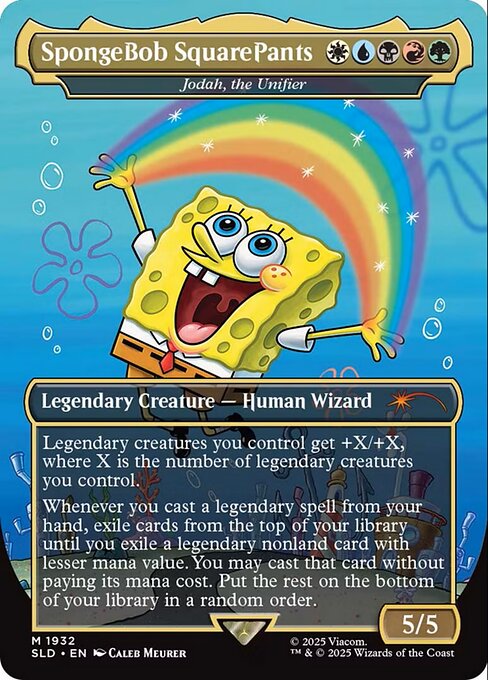
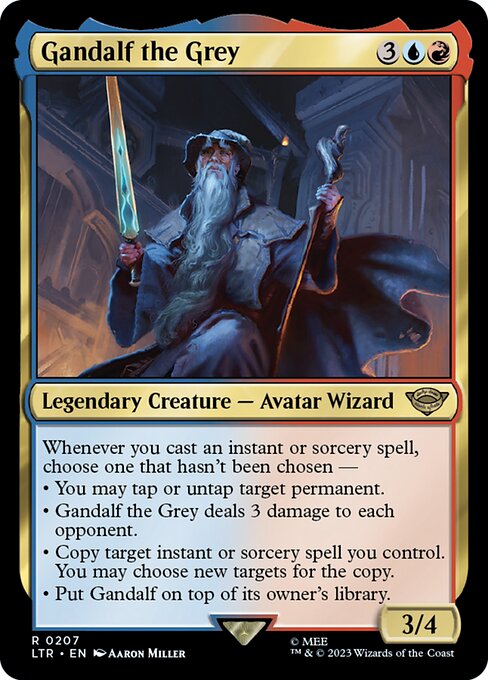
For more than thirty years, Magic has built a vast and recognizable universe, complete with its own planes, characters, and stories. For some players, seeing characters from unrelated franchises sharing the same battlefield breaks immersion and diminishes part of what makes Magic unique. Today, it is entirely possible to find SpongeBob SquarePants ( Jodah, the Unifier ) attacking while equipped with Captain America’s Shield ( Captain America's Shield ), only to be blocked by Gandalf ( Gandalf the Grey ) and Leonardo ( Leonardo, Big Brother ) from the Teenage Mutant Ninja Turtles.


Others argue that relying on external intellectual properties turns Magic into a platform for promoting other brands rather than continuing to develop its own worlds and characters.
Another frequent criticism concerns product fatigue. The number of annual releases has increased significantly in recent years, and some players see Universes Beyond as just another contributor to that acceleration.
The arrival of Universes Beyond in Standard has added a new dimension to the discussion. Previously, it was possible to avoid these products without affecting one’s regular play experience. Now, however, they are part of Magic’s premier competitive formats. For some players, that means the issue is no longer merely a matter of personal preference.
A Matter of Perspective
Interestingly, much of the debate is not really about any specific franchise. Instead, it revolves around a deeper question.
What exactly is Magic: The Gathering?
Is it a fantasy universe with its own identity, one that should be preserved and expanded from within? Or is it a game system capable of accommodating any universe, as long as the result is fun and engaging?
The answer to that question likely determines how each player feels about Universes Beyond. And that is precisely why, several years after its announcement, it remains one of the most debated topics in the Magic community.
Personally…
My initial reaction was one of rejection. I did not like the idea of bringing characters from other franchises into Magic. As far as I was concerned, if Wizards wanted to do a few crossover appearances, Secret Lair already existed and was more than enough.
But then, as has probably happened to many players, things look different when the franchise in question is one you actually enjoy. In my case, that meant The Lord of the Rings and The Hobbit.
In practice, for example, I had wanted to build a Ninja deck for quite some time, and the Teenage Mutant Ninja Turtles (TMT) release finally gave me the opportunity to put one together. It is a deck I genuinely enjoy playing. The abundance of legendary creatures, which is almost unavoidable in many Universes Beyond products, has been less of an issue thanks to playing them in a singleton format such as Australian Highlander.
I won’t pretend otherwise: I’m not particularly excited about Star Trek, which is arriving this coming winter. But then again, who knows? I’ve never been especially interested in superhero comics or movies either, and yet the idea of building a deck around the Marvel set sounds surprisingly appealing.