

This week, a new Universes Beyond set arrived on MTG Arena, this time set in the world of Star Trek. Unlike the other Universes Beyond sets released this year, Star Trek is a franchise I have no particular connection to. I am not a fan, and I know very little about most of the characters on the cards or the many references to the different shows and films.
So I have approached this set more as a Magic player than as a fan of the franchise.
Over the past few days, I have had the chance to play a couple of Sealed events on Arena. The results have been modest, but they have helped me get familiar with some of the set’s mechanics and form an initial impression of the Limited format.
First Sealed: an underwhelming debut
For my first Sealed, which I played the day after the set launched, I initially built a Selesnya deck .
The deck had a good amount of removal: three copies of Common Goal , two of 70,000 Light-Years from Home , and one of Command Decision . It also had three copies of Xenobotanist , which helped ramp into some of my larger creatures, such as Species 8472 .


There were a few interesting small synergies, such as using Type-2 Phaser to tap an opponent’s creature and then take it out with U.S.S. Excelsior, Cutting Edge . Overall, though, the deck lacked especially powerful threats.


I won the first game but lost the next two. At that point, I took another look at my pool and tried a completely different color combination: a Temur deck . I kept many of the green cards and added artifact and starship synergies, along with more ways to generate card advantage.
One of those synergies let me use D'Vana Tendi, Optimistic Ensign to activate the Warp Core twice in a single turn, speeding up my starships. The change did not produce the results I hoped for: I lost the fourth game and finished the Sealed with one win and three losses. I was on the draw in all four games.


Second Sealed: from Golgari to Bant
A couple of days later, I decided to try my luck with a second Sealed.
This time I started with a Golgari deck , with a fairly low mana curve and some graveyard synergies, mainly thanks to cards such as Vash, Freelance Archaeologist and Sela, Tal Shiar Paradox . I also had Support Mission , a spell that let me keep boosting my creatures as they entered the battlefield.


I won the first game against an Orzhov opponent, mostly because I had built up a good number of small creatures on the board. Even so, the deck did not feel very convincing. I felt I had scraped by with a fair amount of luck, and that the deck lacked staying power. So despite the win, I went back to the drawing board.
A much more promising Bant deck
The second deck I built was Bant , with an interesting mana base thanks to two shock lands, Breeding Pool and Hallowed Fountain , plus one copy of Earth, Sector 001 .


I had as many as six lands with different names, which let me make much better use of one of the set’s new mechanics: Strange New Worlds. That meant cards such as Captain Pike, Fullness of Time and The Traveler could become sizable creatures for a very low mana cost.


The deck’s most spectacular card was undoubtedly Excalbian Gamemaster , a 6/6 that could create up to six 1/1 creature tokens at once using lands from my library and, on top of that, distribute +1/+1 counters among our creatures whenever one of them died.

The deck also had three starships (two copies of Enterprise NX-01 and one U.S.S. Cerritos, Following Up ), along with cards that synergized with them, such as Zefram Cochrane, Warp Pioneer .


I felt much better about this second build. I won four of the seven games in the Sealed before losing the last two. Overall, though, the games were slow and close (real battles of attrition, with several outcomes tipping one way or the other partly due to luck).
Real battles of attrition
One thing that has stood out to me in these first experiences with Star Trek is how easily games turn into what are often called grindy games: real battles of attrition. Both players keep building up permanents on the battlefield, trading resources, and eking out small advantages, but it is hard to gain enough of an edge to decide the game.
One combination that contributed to this feeling was Vash, Freelance Archaeologist , Sylvia Tilly, Joy of Discovery , and Dr. McCoy, Surly Surgeon . Vash let me draw a card the first time each turn a card left my graveyard; Sylvia could exile one to put a +1/+1 counter on a creature, triggering that ability. McCoy, in turn, made it harder for a creature with counters to die: if it would be destroyed, its counters were removed and all damage on it was healed. The cards also worked well in pairs, but when I assembled all three, they generated value and resilience turn after turn.


Some of my second Sealed games are good examples. In my first game with Bant, against a Jund deck , we both ended up with a lot of creatures on the battlefield. My opponent had creatures that kept growing through their Landfall synergies, while I had, among other things, the flying threats from my starships. I eventually won after twelve turns.
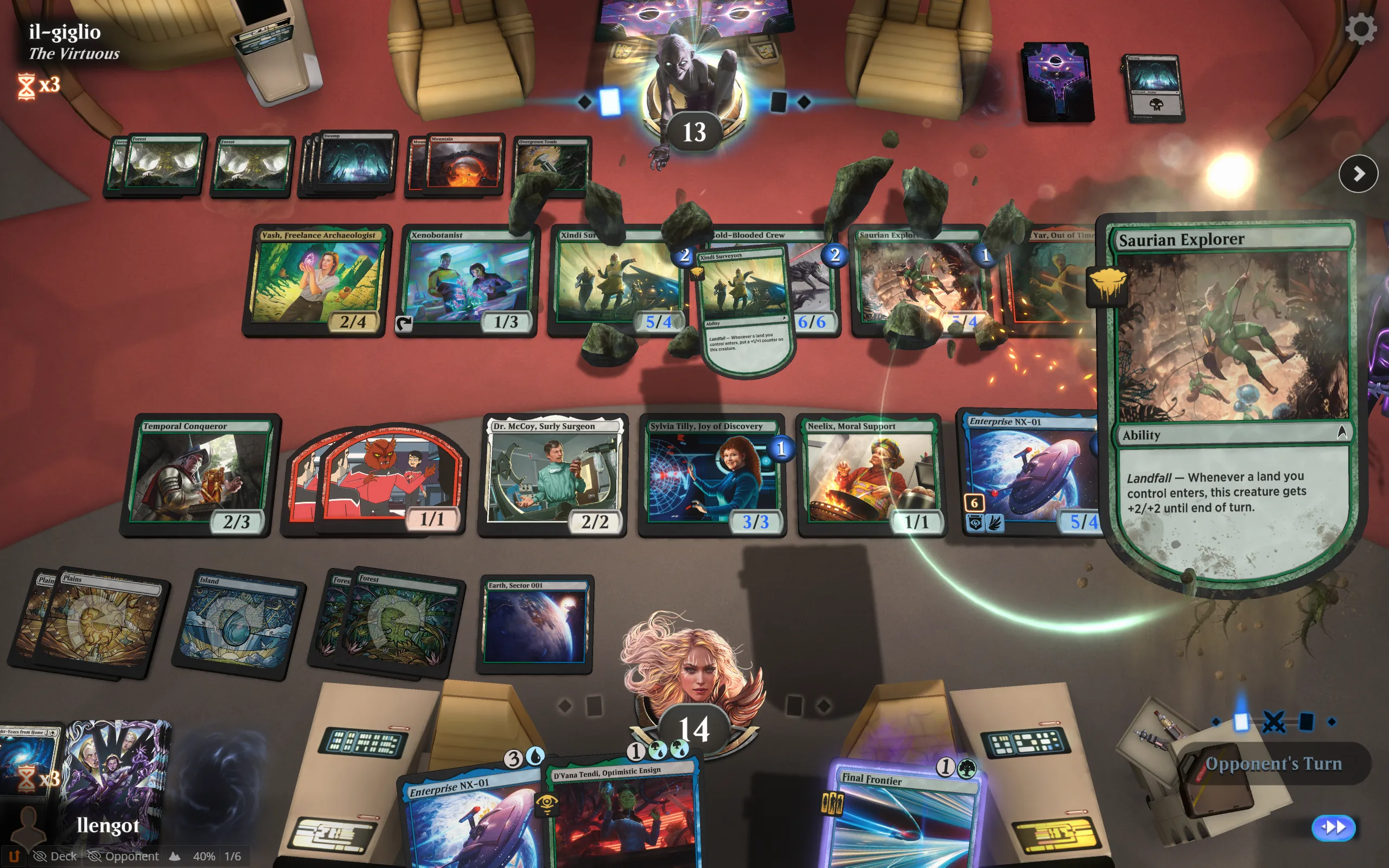
Second Sealed, game 2: a win against Jund after twelve turns.
An even closer game was against a Sultai deck . I won after eleven turns with just one life remaining. By the end, I had as many as eight 1/1 creature tokens, an Excalbian Gamemaster that had grown into a 7/7, and several other creatures on the battlefield. Even so, my opponent still had a substantial board presence.
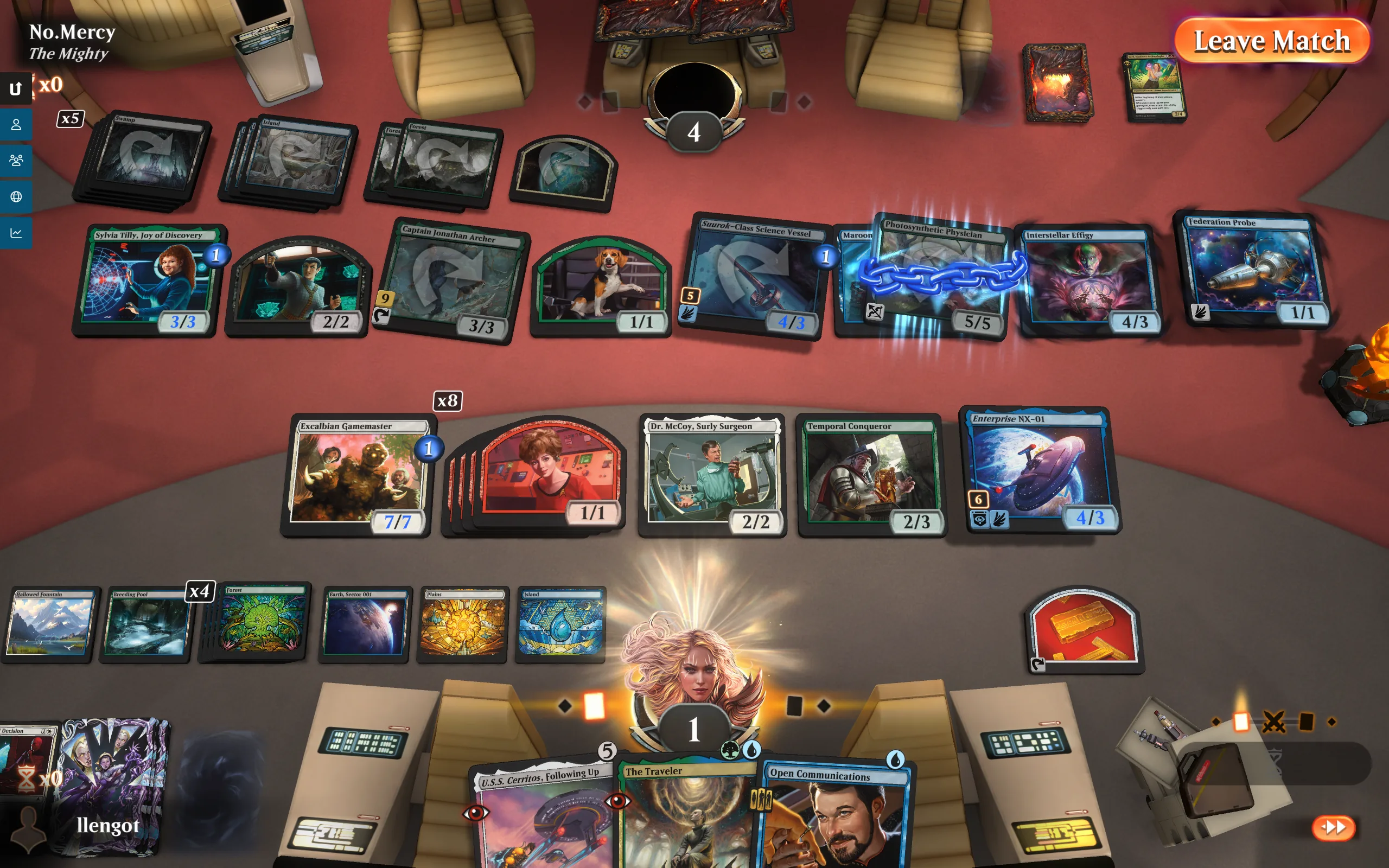
Second Sealed, game 5: a win against Sultai at one life after eleven turns.
Winning at one life… and losing at twenty-four
Curiously, the opposite happened in one of my last two games. I was playing against Grixis and, after thirteen turns, I seemed to be in a very favorable position: I had plenty of creatures on the battlefield, twenty-four life, and had brought my opponent down to just two.
I had even managed to neutralize a Data, New Life that had grown to 16/17 with Marooned . But my opponent kept reusing Ensign Pavel Chekov ’s enter-the-battlefield ability with blink effects, exiling cards from my library until I had nothing left to draw. My twenty-four life did not help much.


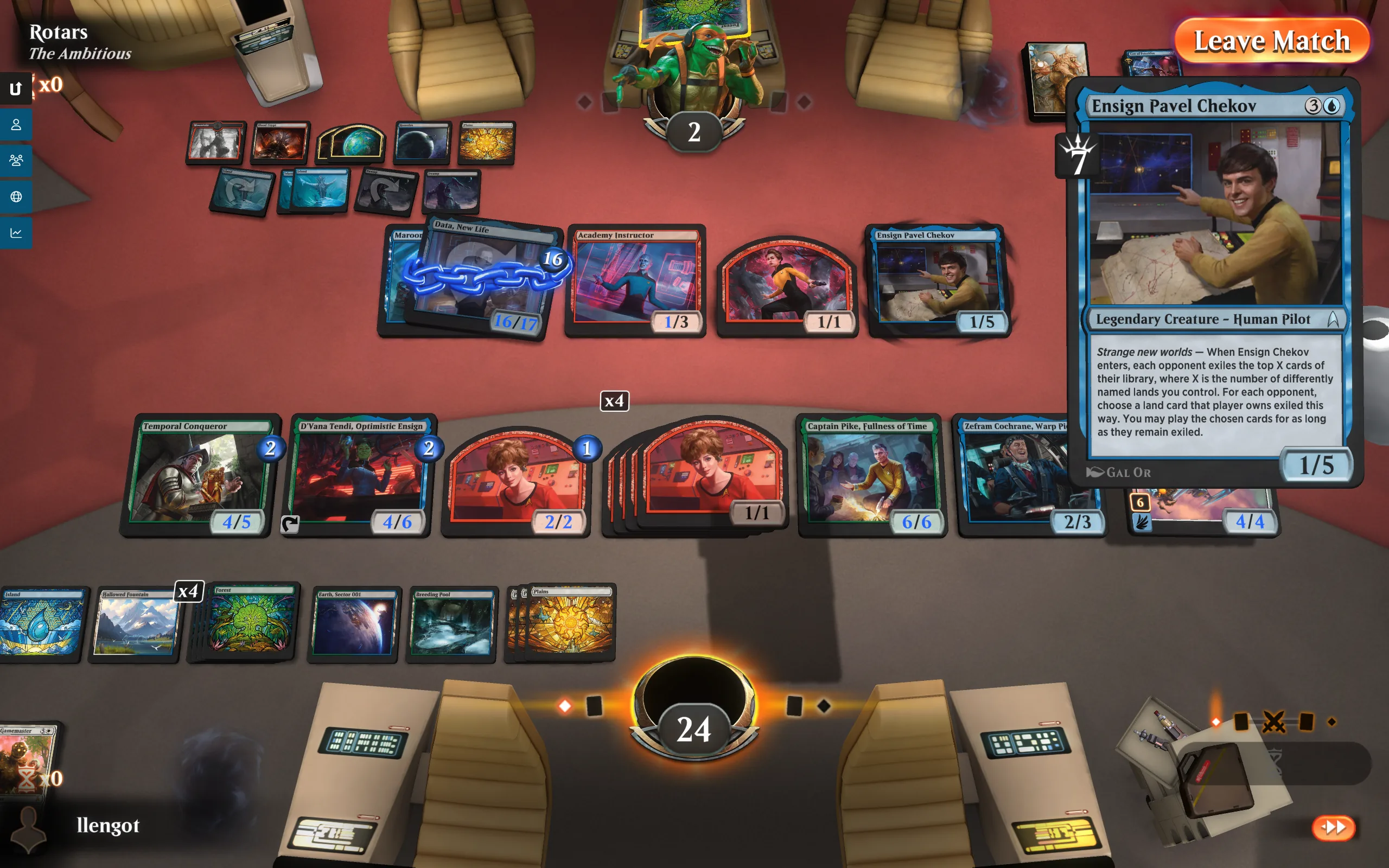
Second Sealed, game 6: a loss against Grixis after thirteen turns, despite ending at twenty-four life.
The final game, against a Rakdos deck, also ended unexpectedly. After sixteen turns, when I thought I had the board well under control, my opponent turned a modest Automated Warfare System into a 7/2 flyer with the help of Type-2 Phaser and Captain's Tutelage . Just like that, almost out of nowhere, I lost.


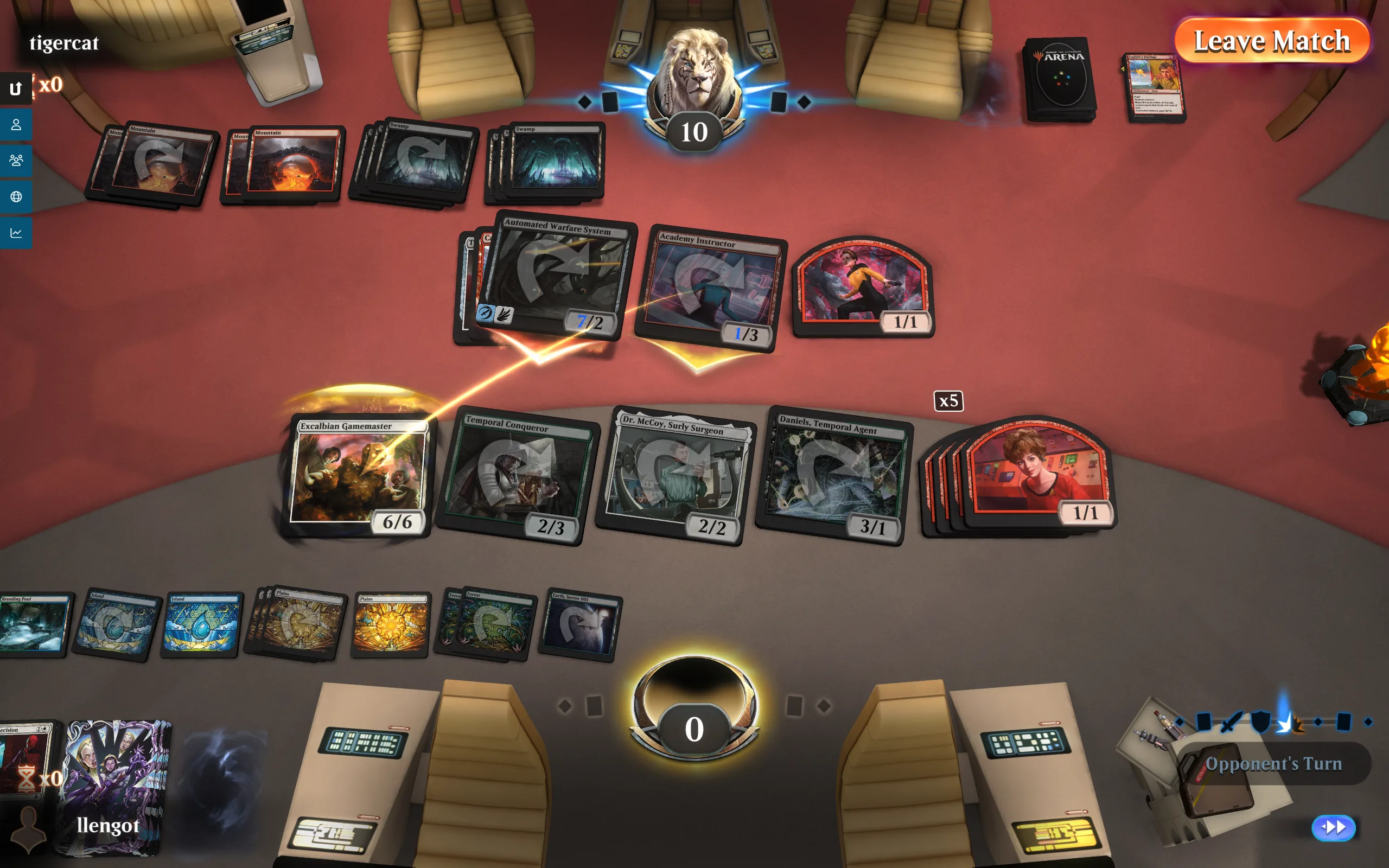
Second Sealed, game 7: a loss against Rakdos after sixteen turns.
In several of these games, after many turns of back-and-forth, I felt the outcome came down partly to luck. Sometimes it seemed to depend on who could draw the right card at the right time.
Is Star Trek a slow format?
These experiences made me curious about the average length of Limited games in recent sets. Here is a summary of my two Sealed events:
| Sealed | Deck | Record | Turns | Average turns |
|---|---|---|---|---|
| First | Selesnya | 1-2 | 24 | 8.00 |
| First | Temur | 0-1 | 8 | 8.00 |
| First total | 1-3 | 32 | 8.00 | |
| Second | Golgari | 1-0 | 8 | 8.00 |
| Second | Bant | 3-3 | 73 | 12.17 |
| Second total | 4-3 | 81 | 11.57 | |
| Total | 5-6 | 113 | 10.27 |
The four games in my first Sealed averaged eight turns. The second averaged 11.57 turns. With Bant, five of the six games lasted more than ten turns, and two went to sixteen.
But how representative is this experience? We can compare it with recent sets using the data from 17Lands and Untapped.gg:
| Set | Premier Draft | Sealed |
|---|---|---|
| Secrets of Strixhaven (SOS) | 9.00 | 8.92 |
| Marvel Super Heroes (MSH) | 9.00 | 8.86 |
| The Hobbit (HOB) | 8.61 | 8.60 |
| Reality Fracture (ECL) | 9.81 | 9.80 |
| Star Trek (TRK) | (n/a) | 9.10 |
| My Star Trek experience | (n/a) | 10.27 |
The data for the previous four sets comes from 17Lands, while the Star Trek data comes from Untapped.gg, which had a sample of around 54,000 Sealed games when I checked. So we are comparing two different sources, and the set had only been available for a few days.
These figures do not make Star Trek look especially slow in terms of turn count. It is a little slower than The Hobbit or Marvel Super Heroes, but it does not reach the numbers for Reality Fracture. On the other hand, Untapped.gg puts the average Star Trek Sealed game at 9.3 minutes. For comparison, Premier Draft games take 9.2 minutes in Reality Fracture, 8.3 in Marvel Super Heroes, and 7.8 in The Hobbit. Even though that compares Sealed with Draft, I find it interesting.
Perhaps the key is not so much how many turns games last, but how much happens during each turn.
A format with lots of resources?
I suspect some of Star Trek’s mechanics contribute to these battles of attrition. Starships, thanks to Station, give you a way to make use of your creatures on the battlefield even when they cannot attack.
Beam Me Up, on the other hand, lets you cast certain spells from your graveyard again by returning a creature to your hand. That can also let you reuse that creature’s enter-the-battlefield ability when you cast it again. Mechanics such as Strange New Worlds and Landfall also keep generating value from simply playing lands as the game goes on.
All of this means that even in the late game, players still have options and ways to eke out small advantages. It has not felt like a format where it is hard to do things; it has felt like a format where both players can do a lot, but neither can easily break the stalemate.
Conclusion
Of course, you cannot draw conclusions about a Limited format after playing only two Sealed events and eleven games in total. My experience with Sealed may not represent Draft, either. These impressions could come down to the decks I built, the decks I faced, or simply my lack of experience with the format.
In any case, this has been my first experience with Star Trek: fairly long games, crowded boards, lots of small synergies, and real battles of attrition where sometimes everything seems to be going your way and you still lose, while other times you manage to win when the game seemed all but lost.
We will see whether these impressions hold up once I start playing my first Drafts in the set.